

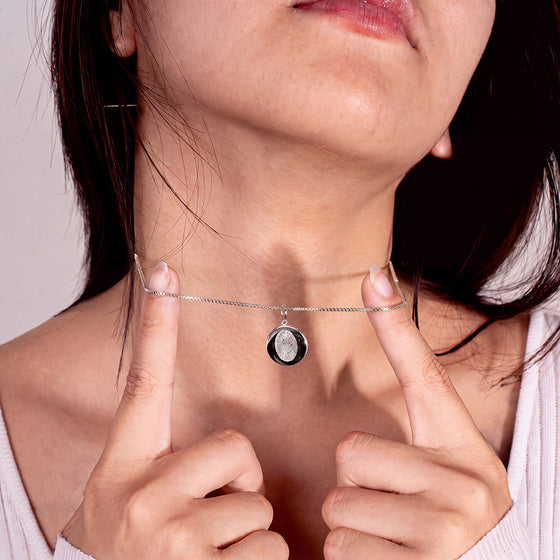

Is it possible to take a fingerprint of a deceased loved one?
When someone you love has passed away, there is often a strong wish to hold on to something truly personal. A fingerprint can be more than a template. It is a quiet keepsake that makes closeness visible, without needing many words.
The honest answer to whether it's still possible: often, yes, if you ask early enough. In practice, there are three situations:
- A print already exists, for example from an earlier time, from the funeral director, or as a wax impression. A piece of jewelry can then be made from it right away.
- A print can still be taken. This is possible until the burial or cremation, most easily through the funeral director.
- A print is no longer possible. Then handwriting, a name, or a date can become a personal keepsake.
The process: who takes the fingerprint, and when?
The funeral director as your first point of contact
After a death, the funeral director is usually your first contact. Many funeral directors will take fingerprints on request while caring for your loved one, with ink on paper or as a wax impression. It's best to mention this in your very first conversation, even if you haven't decided on a piece of jewelry yet. Once a print exists, you can use it later, in your own time.
In a hospital, hospice, or nursing home
If you are saying goodbye there, you can ask the staff whether you may take a print yourself, for example with an ink pad and light-colored paper. If that isn't possible, the funeral director can take care of it once your loved one is in their care.
With a cremation: before the crematorium
With a cremation, the funeral director brings your loved one to the crematorium. That's why the print should be taken beforehand, while your loved one is still in the funeral director's care. Whether a print can still be taken at the crematorium itself varies from place to place. Please don't rely on it, and if in doubt, ask through the funeral director.
Step by step
- Ask the funeral director about the fingerprint as early as possible.
- Decide which finger it should be. Often it's the thumb or the index finger.
- Have the print taken on paper or as a wax impression, ideally several at once.
- Photograph or scan the print. Many funeral directors will also send you a photo or scan.
- Choose the piece of jewelry and upload the template, or send it in later.
- Once we have the template, your piece is usually made within 4–7 business days.
Print kit or ink pad?
With our fingerprint jewelry, you can add a free print kit with instructions to your order. It's helpful if you'd like to take the print yourself or give it to the funeral director. But because the kit first has to reach you by mail, there often isn't time for it after a loss. In that case, an ink pad and light-colored paper are enough, or the funeral director can take the print with their own supplies.
A quiet keepsake doesn't have to be big. It just has to feel right.
Necklace, bracelet, charm, or ring: finding the right keepsake
At Mizodia, the fingerprint is transferred to the jewelry using diamond engraving, finely and in rich detail. The pieces come in 18K gold-plated stainless steel in gold, white gold, or rose gold, and some are also available in solid gold.
Fingerprint necklace
In grief, many people don't want an eye-catching piece, but something they can wear close to their heart. The Fingerprint Necklace has a round pendant of 15 or 20 mm and an adjustable chain of 44 cm + 5 cm. If you'd like a necklace in gold, the Fingerprint Necklace Solid Gold is available in 333 (8K) or 585 (14K) gold.
Fingerprint bracelet
A bracelet is more understated, yet it stays visible in everyday life whenever you want to see it. The Fingerprint Bracelet has a 15 mm pendant and adjusts from 16 to 19 cm.
Fingerprint charm
If you already wear a necklace or bracelet that means a lot to you, you can add a Fingerprint Charm to it.
Fingerprint ring
A ring is an especially close way to remember someone, because it stays on your hand every day. The Fingerprint Ring is a simple signet ring with diamond engraving, made of 18K gold-plated stainless steel in gold, white gold, or rose gold, in ring sizes 52, 54, and 57.
Mizodia jewelry is gentle on the skin, waterproof, and made for everyday wear. It also comes with a 2-year repair or replacement guarantee for damage caused by defects in materials or workmanship.
A memorial necklace for the whole family
Often several people want to wear the same keepsake: children, grandchildren, siblings. A single print is all you need. You can use the same template for several pieces, for example a memorial necklace for each family member, or a necklace and a ring for two people.
There are also pendants with two or three prints. They let you combine your loved one's fingerprint with that of a partner or child.
Sending your template later: still possible
You don't need to have the print when you order. After your purchase, you'll receive a link by email to upload the template whenever the time feels right for you. We only begin making your piece once we have the template.
Suitable templates include a photo or scan of a print on paper, an ink pad print, or a photo of a wax impression, for example from the funeral director. Accepted file formats are PNG, JPEG, WEBP, and HEIC. These tips help:
- Photograph in daylight and directly from above.
- The entire print is in the picture, and the lines are sharp.
- Photograph a wax impression with light from the side so the lines become visible. No flash.
- If there are several prints, choose the one with the clearest lines.
When a fingerprint is no longer possible
Sometimes it's too late for a print, or it simply wasn't possible in the moment. Even then, the memory doesn't have to be lost. Handwriting jewelry can be deeply personal, perhaps with a signature or a few words from an old card. An engraving with a name, a date, or a short message also creates a quiet keepsake for every day.
A personal piece of jewelry can make closeness visible when words fall short.
A gentle next step
You don't have to have everything figured out right away. The only thing that matters at first is asking the funeral director about the fingerprint early. Once the print exists, you can decide in your own time which piece feels right.
For many people, that is exactly the value of memorial jewelry: not showing something big, but carrying something important with you. You'll find meaningful pieces in our memorial jewelry collection.


