

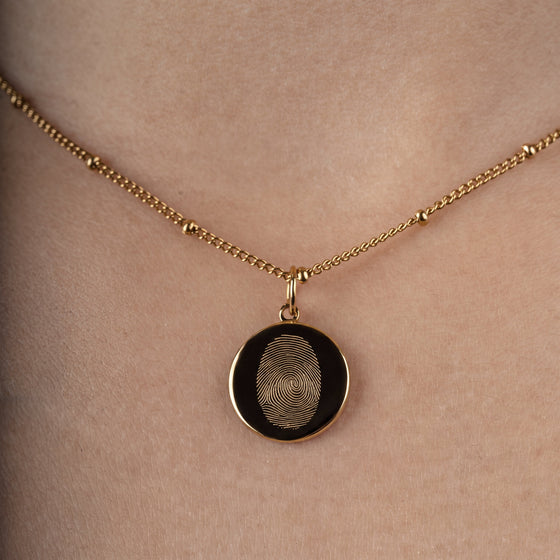

Short answer: “18K gold plated” means a piece of jewelry is made of another metal and coated with a thin layer of 18-karat gold. 18 karats equal a fineness of 750/1000, so the gold layer is 75 percent pure gold. The piece itself is not solid gold. For our necklaces, the core is stainless steel and the surface is 18K plated in gold, white gold, or rose gold.
Here you’ll learn what the label really means, how long plating lasts, how to care for it, and when solid gold is the better buy.
What exactly does 18K gold plated mean?
18K gold plated describes only the surface: the karat number applies to the gold layer, not to the whole piece. Underneath is a base metal that provides shape and strength. At Mizodia, that is stainless steel. That’s why our product pages say, for example, “stainless steel 18K gold plated.”
Good to know: the karat number tells you about the color and quality of the gold layer, but nothing about its thickness. A gold-plated piece therefore has no meaningful material value that you could cash in at a gold buyer later. It is an affordable way to wear gold.
What does 18 karat mean?
18 karat means 18 out of 24 parts of the alloy are pure gold, which is 75 percent. Karat is a unit for gold content, and 24 karat would be pure gold. In Germany, gold content is usually stated as fineness in parts per thousand, as a stamp like 333, 585, or 750.
| Karat | Fineness | Gold content | Typical for |
|---|---|---|---|
| 8 karat | 333 | 33.3% | entry-level solid gold jewelry |
| 9 karat | 375 | 37.5% | solid gold jewelry |
| 14 karat | 585 | 58.5% | high-quality solid gold jewelry |
| 18 karat | 750 | 75% | gold plating and solid gold jewelry with a rich color |
| 24 karat | 999 | 99.9% | bars and coins, too soft for jewelry |
The higher the gold content, the warmer and more yellow the color. That’s why 18K plating has a rich, classic gold tone.
Gold plated, vermeil, or solid gold: what’s the difference?
The difference is the core: with gold-plated stainless steel only the surface is gold, with silver vermeil the core is 925 sterling silver, and with solid gold the entire piece is made of a gold alloy. That affects price, durability, and care.
| Material | Core | Gold | Color over time | Example at Mizodia |
|---|---|---|---|---|
| Stainless steel 18K gold plated | stainless steel | layer of 18K gold | layer can wear off at friction points | Singapore chain, €29.90 |
| Silver vermeil | 925 silver | gold layer | like any plating, depends on friction and care | varies by product |
| Solid gold 333 or 585 | gold alloy | throughout | stays, because there is no coating | Singapore chain 45 cm, 1.0 mm: €149.90 to €299.90 |
How long does 18K gold-plated jewelry last?
How long plating lasts depends mainly on how often and how you wear the piece. Where there is a lot of friction, such as at the clasp, on the chain links, or on the back of a pendant, the gold layer wears off first. Sweat, perfume, lotions, chlorine, and salt water speed this up.
The advantage of a stainless steel core: stainless steel is considered sturdy and corrosion-resistant. If the gold layer gets thinner in one spot, a silver-colored base shows through, but the piece itself stays stable. Chains and bracelets that are constantly moving usually show wear sooner than a pendant resting quietly on the skin.
A blanket figure in months or years would therefore be misleading. With the right care, though, you can noticeably extend the life of the plating.
How to care for gold-plated jewelry
The best care for gold-plated jewelry is avoiding friction and chemicals. These steps keep the surface looking good longer:
- Put it on last: Perfume, lotion, and hairspray first, then your jewelry. That way no residue lands directly on the gold layer.
- Take it off for water and sports: Remove your jewelry for swimming, showering, the sauna, and workouts. Chlorine, salt, soap, and sweat attack the surface.
- Take it off for cleaning and gardening: Cleaning products and soil act like an abrasive on the gold layer.
- Clean gently: Wipe the piece with a soft, dry cloth after wearing. If needed, use lukewarm water with a drop of mild soap, then dry it well.
- No polishing cloths or pastes: Silver polishing cloths and polishing pastes remove the gold layer. Toothpaste and ultrasonic cleaners are off-limits too.
- Store pieces separately: Keep each piece in its own pouch or in a jewelry box with compartments. That way pieces don’t scratch each other and chains don’t tangle.

Gold, white gold, rose gold: what does the color mean?
With plated jewelry, the color comes from the gold layer: 18K gold plated gives yellow gold, 18K white gold plated a light, silvery tone, and 18K rose gold plated a warm rosy tone. That’s exactly how the variants are listed on our product pages. With the anchor ball chain, for example, you can choose all three colors. It costs €29.90 and is 44 cm long with a 5 cm extension, so it adjusts between 44 and 49 cm.
The same colors are available for our personalized pendants with diamond engraving in 15 mm or 20 mm, for example with a fingerprint, paw print, or handwriting. Pick the color that matches the jewelry you usually wear, and choose the same tone for chain and pendant.
When is solid gold worth it instead of plated?
Solid gold is worth it if you want to wear a piece every day, rarely take it off, or pass it on later. Because solid gold is a gold alloy all the way through, there is no layer to wear off, and a jeweler can polish out scratches. Gold-plated stainless steel, on the other hand, is the right choice if you like to mix colors, switch things up often, or give a personal gift on a smaller budget.
At Mizodia, solid gold comes in 333 and 585, each in yellow gold and white gold. The solid gold fingerprint necklace costs €359.90 to €959.90 depending on alloy and chain, and the chain is a fixed 45 cm. The fingerprint necklace in stainless steel 18K gold plated costs €109.90 to €129.90. You’ll find all solid gold pieces under solid gold jewelry.
Bottom line: wear gold without paying for solid gold
18K gold plated means gold with 750 fineness on the surface and another metal underneath, in our case stainless steel. You get a rich gold tone at a fair price, but you should protect the gold layer from friction, water, and cosmetics. If you’re looking for a piece for life, solid gold is the better choice. For everything else, you’ll find the right base in gold, white gold, or rose gold in our necklaces.


